Horse Racing Artwork From Someone Who Actually Rode the Races
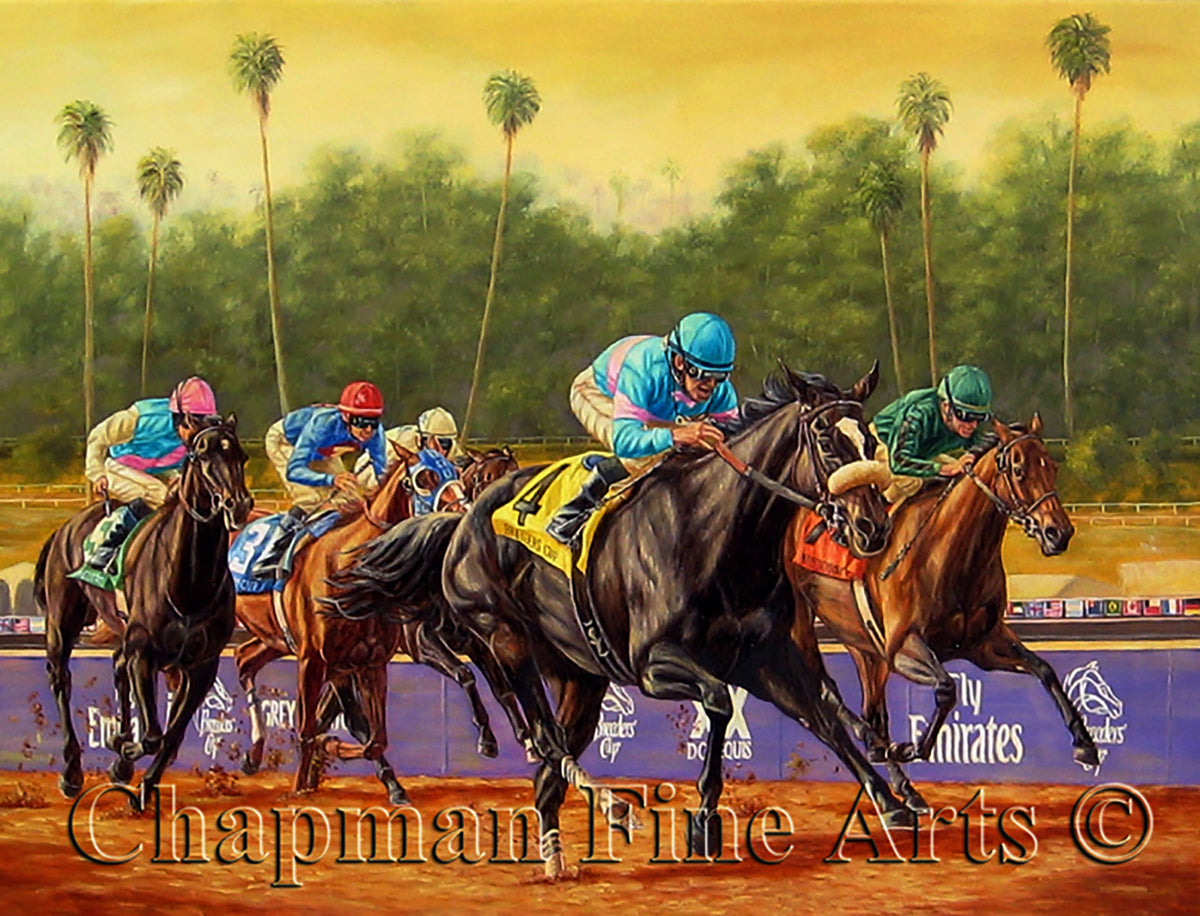
There is a specific kind of horse racing artwork that people who follow the sport can spot immediately - and then there is everything else. The difference is not about technical skill. It is about whether the painter knows what they are looking at. A field of horses coming out of the far turn looks a certain way on television and completely different from the saddle. The angle, the proximity, the noise, the way the whole field compresses and spreads mid-turn - none of that translates from a broadcast into a painting unless the painter has been inside it.
Tom Chapman has been inside it. He rode thoroughbreds professionally for nearly twenty years on the California circuit - Bay Meadows, Del Mar, Santa Anita and beyond. He started in 1977 and was still racing in 1994. By the time he put the brushes to the track scenes he had been accumulating in his memory, he was painting from direct experience, not from race footage. That is the foundation his horse racing artwork is built on.
What Makes Racing Artwork Accurate - and Why It Is Harder Than It Looks
Painting a horse race is not the same as painting a horse. A single horse portrait gives you time - you study the anatomy, you understand the subject, you control the light and composition. A racing scene gives you almost nothing. The field is moving. The horses are overlapping. The jockeys are forward in the irons, hands low, weight shifted. The silks are bright and specific - owners' colors that racing fans recognize immediately when they are right and notice immediately when they are wrong.
Tom's compositional decisions in his racing paintings reflect this understanding directly. In the Affirmed painting at the 1978 Kentucky Derby Clubhouse turn, he made one deliberate choice that shows how this works in practice: he pushed the background into a blur, leaving only an illusion of the treeline at Churchill Downs, and kept the palette unified across the entire canvas - except for the pink of Steve Cauthen's silks. Everything in the painting points to Cauthen. The focal point is the jockey, not the horse. That is a decision that only makes sense if you understand what a jockey's relationship to a race looks like from inside the sport.
This is what separates Tom's horse racing artwork from generic equestrian painting - not just technical accuracy, but interpretive understanding. He knows which moment in a race matters most, which angle tells the story, and where the emotional weight of a specific race actually lived.
The Racing Paintings - Specific Races, Specific Moments
Tom's horse racing collection is not a set of generic action paintings. Each piece is grounded in a specific race, a specific moment, or a specific dynamic that Tom found worth painting. Here is what is in the collection and what each piece covers.
Affirmed vs. Alydar - 1978 Belmont Stakes
This is the finish of the race that completed Affirmed's Triple Crown - and the most contested finish in that rivalry. Alydar had collared Affirmed down the backside of the mile-and-a-half race. He nearly got by Affirmed multiple times in the stretch. They came down to the wire together and Affirmed held on by a nose. Alydar finished second in all three Triple Crown races in 1978, each time closer than the last - losing the Kentucky Derby by one and a half lengths, the Preakness by a neck, and the Belmont by a head. Tom painted the Belmont finish specifically because it was the race where the rivalry was most visible. Alydar was later inducted into the Racing Hall of Fame in 1990.
Affirmed - 1978 Kentucky Derby
The companion piece to the Belmont painting covers the first leg of the Triple Crown, Affirmed at the Clubhouse turn at Churchill Downs with 18-year-old Steve Cauthen aboard. As noted above, Tom unified the palette and isolated the silks. Cauthen was the youngest jockey to win the Triple Crown at that point. Affirmed's trainer Laz Barrera was quoted at the time: "Affirmed was greater than Secretariat, Seattle Slew and all the rest. Why? None of them had to face the great Alydar."
American Pharoah - Haskell Stakes, Monmouth Park 2015
After winning the Triple Crown at the Belmont - ending the 37-year drought since Affirmed - American Pharoah came back six weeks later and won the Haskell Stakes at Monmouth Park in New Jersey by six and a half lengths. Tom painted this race as a portrait of the horse in full stride, the silks vibrant against a minimal background. A collector who bought both the small and medium prints wrote: "The muscle tone stands out beautifully and you can feel all the power of this magnificent horse." The piece is available in three sizes.
American Pharoah - Triple Crown Narrative Painting
The larger, more complex American Pharoah piece is a full narrative of the 2015 season - all three Triple Crown wins represented, the Belmont trophy presentation, jockey Victor Espinoza, trainer Bob Baffert, his wife Jill and their son Bode, and owners Ahmed and Joanne Zayat. Tom made a deliberate decision to include everyone involved in the achievement, not just the horse. There are 800 prints total across all sizes. No artist proofs. He priced it across seven sizes specifically so more people could own it.
Zenyatta - 2008 Ladies' Classic and 2008 Lady's Secret Stakes
Two separate paintings of Zenyatta cover two specific wins. The Ladies' Classic painting features Zenyatta eight wide - Tom accentuated the jockey's silks against a dark background to give the painting its visual tension. The Lady's Secret painting captures her winning by three and a half lengths, jockey Mike Smith giving her a single tap on the shoulder as her ears pricked, looking for competition that never came. Both are available as signed prints with certificates of authenticity.
The Calm Before the Race
This painting steps back from the competition itself and shows the walking ring at Santa Anita Park - the period before the horses enter the gate that carries its own specific tension. Tom described this space in his own writing as one of the places in horse racing that captures the excitement of the sport in a way the race itself sometimes does not. For people who have spent time at the track, this scene is immediately recognizable. For people who have not, it opens up the part of racing that broadcast coverage misses entirely.
A Clean Break
This painting covers the moment the gates open - horses breaking from the starting gate simultaneously. As a subject, it requires understanding what the gate looks like from the jockey's position and what the field looks like in the first half-second of a race. Tom painted this from that knowledge.
Racing Silks Commissions
Tom also takes commissions for racing silks paintings - original oil paintings of an owner's specific colors and silks. These are original commission pieces, not prints. If you are an owner and want your silks documented in oil, the conversation starts with a phone call to discuss size and price.
The Tone Tom Brings to Racing Scenes - and One Painting That Shows It Differently
Tom's sense of humor comes through occasionally in his racing work. The piece titled Bareback Handicap - also known internally as Naked Jockeys with the Horses Wearing the Silks - is exactly what the name suggests. The horses are painted in the owners' colors, and the jockeys are nude, though Tom gave them helmets and boots. He has described painting it as a way of breaking out of the repetition of conventional racing compositions: he had been painting straightforward racing scenes for a stretch and wanted to do something structurally similar but formally strange. The horses painted in the owners' silks were the starting point. The nude jockeys followed logically from there. It is the kind of joke that only makes sense coming from someone who has actually worn the silks.
Who This Work Is For
Tom's horse racing artwork is bought primarily by people who follow thoroughbred racing seriously - owners, trainers, riders, longtime fans who were present for specific races and want those moments on a wall. It is also bought by collectors who appreciate sports-inspired fine art that carries genuine documentary accuracy rather than generic action imagery.
If you attended a specific race that Tom has painted, the prints are available in multiple sizes with free shipping and a 30-day money-back guarantee. If you want a racing scene that is not currently in the collection - a specific horse, a specific track, a race you were involved in - Tom takes commissions for original racing paintings. Size and composition determine the price, and the conversation starts with a call.
Browse the full horse racing collection and the Hall of Champions.
Chapman Fine Arts